
Skip to content

Marketing at the Speed of Intelligence

What Happens When AI Stops Being a Feature?

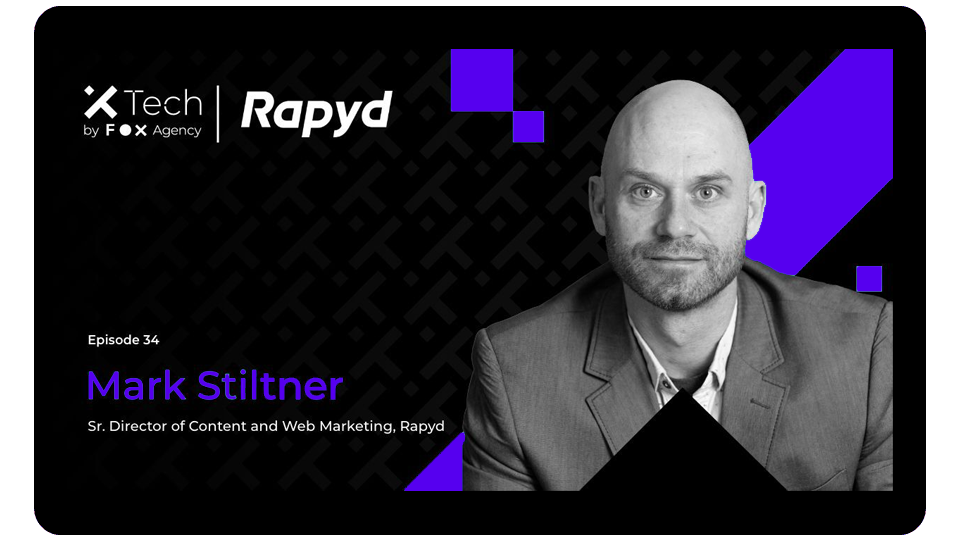
Mark Stiltner, Senior Director of Content & Web Marketing at Rapyd, shares how AI adoption is driving scale and speed without losing the human story. On the XTech Podcast, Mark explains how Rapyd rebuilt workflows with AI at the core.

What You’ll Learn

  • Why the real risk of AI isn’t hallucination, it’s mediocrity
  • How a three-person team ships 30–40 blog posts a month without losing quality
  • Why marketers are now “AI native” leaders inside the business

Transcript

Ready [music] to explore the extraordinary world of tech? Welcome to the XTE podcast, where [music] we connect you with the sharpest minds and leading voices in the global tech community. [music] Join us as we cut through the complexity to give you a clear picture of the ideas, innovations, and insight that are shaping our future. >> Hello [music] and welcome to Xtech podcast by Fox Agency. I’m your host Debbie Forester MBE. I’m a tech portfolio [music] consultant and an advocate and

campaigner for diversity, inclusion, and innovation in the tech industry. I’m delighted to be [music] working with Fox Agency as the host for the Ext. [music] Now, today I am delighted to be joined by Mark Stilner. He’s the senior director of content and web marketing at Rapid. Welcome, Mark, to the show. >> Hey Debbie, thanks for having me. Okay. So, Mark, we want to get to know you as a human being before we understand you in tech. Some of my guests were born with a laptop in the hand. Others, like

me, woke up and accidentally found themselves in tech. How about you? How did you get into the world of tech? >> Well, I went to college for advertising. I really didn’t know what I wanted to do when when I went to college. Most people don’t. I knew I wanted to be creative. I I loved writing. I loved storytelling. And I took these ad classes and realized, hey, this isn’t boring. I can sit here. I can come up with really interesting ideas and got kind of hooked. So, I ended up graduating uh

with a focus on copywriting and started working in an agency. When I started working at an agency, it was really hard to stand out. You know, everybody wanted to work on the big accounts. Somebody, you know, told me, “Oh, you’ve got to get on the Sprite account. They’ve got LeBron James and you’ll, you know, you’ll meet these big time people and that’s how you make your career.” But it was just everybody trying to stand out on the same things. And I realized that if I wanted to, you know, break out from

from the crowd, I needed to figure out another way to do that. And there was one account there. It was a financial technology company. Nobody wanted to touch it. It was super boring. So I took it on. And very quickly, I was working directly with our seale leadership at the agency. I was working with top people at the client that we were working on. And it wasn’t very long before I stopped being the guy who would take the tough, difficult financial and technology clients to being the only guy

who could take them. And that really gave me a niche that I could leverage to to grow in my career. And so I really started focusing on those, but I I didn’t stop being creative. I really focused on how I could be creative and make that type of work just interesting and beautiful and relevant to people. And uh naturally over time I just kind of moved from the agency side onto the client side. Started working with Rapid internally developing their content, helping to develop their brand and that’s how I got here.

>> Fantastic. It’s not easy doing what you do and that’s why you you gravitated towards it. You mentioned about how to make you know great content for that. It translating technical content into compelling stories is not easy. How do you approach making complex fintech principles and their concepts accessible to different audiences? >> So, here’s the secret about human nature that that I found is that most people don’t really know how anything works. I mean, think about it. Like, you get up

every morning, you put your pants on, but do you really know how a zipper works? I mean, you know how to close it, but if I asked you to build one, you couldn’t. And the thing is, you don’t need to. I I think the biggest problem that people run into with tech is they try to explain what the product does instead of explaining what it does for me. And when most people ask how does this work, what they’re really asking is how is this going to work for me? What does it do for me? And so you really

just have to start by doing the hard work of understanding what the product is that you’re selling and understanding who your audience is and then having the good sense to not tell anybody those things. You know, it’s it’s difficult to say like, “Oh, I’m going to do all this work to figure this out and then I’m not just going to put that on the page.” But that’s exactly what you have to do. That’s your context. It’s like if you’re an author writing a novel, you might go

into an incredibly deep exploration of who your characters are, but the reader doesn’t see that, they sense it. And and it’s the same in in advertising and in marketing. >> That’s a difficult journey. You probably have to take your team through. In tech, we can get so excited at how hard it was to build it and all the cool features that we want to do. But I think we try to do what you say. We want to tell you what the product does and how it works >> and then we [clears throat] just become

noise, don’t we? Yeah, it it all ends up kind of sounding the same. You know, if if you just say what it does, you speak over your audience. So, what most people do to try to make it relevant is they go to pain points. They say, “Okay, well, what what are the pain points that it solves?” But the problem that you run into there is that everything solves basically the same pain points. Like, what are the pain points that I as a business person have? It something doesn’t let me scale, it costs too much,

it’s really slow, or it’s hard to use. I mean, that’s pretty much it. But if I come to you and say my product is scalable, it’s faster, it’s less expensive, and it’s easy to use. I haven’t said anything new or interesting. I just sound like everybody else. So, what you’ve got to do is do that hard work and find just that point. Find that place where the audience and the product meet, where you can say something incredibly insightful that allows me as the as the recipient to

picture myself in a world with that product. and like what I see and that it just it just takes that little bit of extra step of storytelling. Uh for instance, I was working on something today or earlier this morning um for a new product. I can’t give too many details about it yet, but it’s it’s a product that Rapid’s working on to make uh basically money transfers faster. And yes, it’s quick, but the headline that we worked on is nothing moves faster than the speed of light except your

money. And I like that line because it gets to the pain point of, hey, my money moves slow, but it also has a it has a grain of truth to it because when you’re sending something digitally through fiber optic cables, you’re essentially sending it at the speed of light. So fundamentally, we’re making your money move at light speed, but it says it in an interesting way and it gets to the benefit without dragging people down into the features and allows you to see yourself in that situation. So that’s

what I try to get to is something where it’ll speak to the audience in between sips of coffee when they’re, you know, reading their emails, in between Zoom calls, in those quick moments they have to make a decision. And to do that, it needs to be able to kick hard and sound self-evident and truthful and and interesting. >> Fantastic. You got these wonderful, compelling stories, but you’re trying to tell them. You’re trying to position Rapid as a thought leader in a really crowded fintech space through content.

Is there any secrets there you can share with us? I think when you’re in a crowded marketplace, there’s only really two ways to stand out. You can be really prolific or you can be really interesting. And at Rapid, we try to do both. So, from a prolific standpoint, it’s it is leveraging new tools, things that AI makes available to produce a lot of content. We’re producing like between 30 and 40 blog posts a month right now on a threeperson team, which is it’s a lot of content to be generating. and and

we’re also doing ebooks and reports and other other types of assets on top of that. So, we do try to be prolific and we use AI to enable that. And then on the being interesting side, you got to find your secret weapon. At Rapid, our secret weapon is some really really smart thought leaders that are subject matter experts on on their topic. you know, whether it’s, you know, stable coins or crypto or payment regulations in Europe or whatever it is that our audience might be interested in, we have

people who can go really, really deep on those topics and we leverage them. Now, back to the point of meeting your audience where they are. The way we do that is we sit down and have in-depth conversations, actually pretty similar to the one that you and I are having right now, to pull that information out, and then we process it into something that’s useful for the audience. Um, and that gives us basically the foundation. So we’re not taking AI and saying, “Hey, write an article for us.” We’re taking

experts pulling that information out and then having AI help us turn that into 40 articles. >> So tell me more about that because I, you know, I don’t think I have a single episode go by that we’re not talking about what AI is doing. I know that you have often described AI as an accelerator, not a replacement, because that’s always the great fear. Is that is it coming for my job? You know, are you living by this idea at at Rapid? Rapid is absolutely embracing AI and we’re actually seeing a lot of success with

it. One of the stories we’ve been telling a lot recently actually not just me but other people at Rapid who are speaking to to podcast, speaking to the media, giving talks. One of the things that keeps coming up is we are having success in a world where a lot of initiatives are failing. So I think I I read a study from McKenzie recently that said something like I think it was McKenzie said something like 80% of initiatives were stalling. So people were implementing AI but they weren’t getting anywhere with it. And what we

found at Rapid, our kind of secret to success has been this sort of top down model. So what we found is that it can’t just sort of be this bottom up sort of like bubbling up of trying to use AI. It’s really got to be led from the top down and enabled. So we say if it’s not CEO, it’s dead. And that doesn’t mean that that our CEO literally has to be like sitting there showing us how to use AI, but it means that it has to be top down driven and say, “Hey, this is going to be not just something that we bolt

onto our business. This is going to be the core of our business, and I’m going to give you the tools and the capabilities and the direction needed to to make that happen.” And so that that top down leadership, I think, has been a part of our recipe for success. I think the other thing is not treating AI like a feature. So this is a mistake that people make is they say, “Oh, I’ve been doing things a certain way. I’ll just add AI to that. I’ve been writing blog posts. I’ll just like, you know, have AI

write it the same way or I’ll just add it to my workflow or I’ll add an AI chatbot to my product and that’s AI. And that’s not how you get success. How you get success is stripping down the model and rebuilding it with AI at the core. So, you know, I think this goes back to the early days of the internet when you had companies like Blockbuster saying, “Oh, we’ll have a website. Sure, you can see what movies we’ve got.” And then you’ve got somebody like Netflix who

comes along and says, “No, the internet fundamentally changes the way that business is done. We’re going to break this down and build it back up with the internet at the core.” And that’s how you succeed. And it’s really the same with AI. You need to say this fundamentally changes the way that work is done. Break it down into its individual steps and build it back up with AI at the core. And so from our content program that looks like less of just you know copying and pasting briefs

into AI and more like again rebuilding that process, identifying subject matter experts, creating interesting ways to pull information from those experts and then actually building models that take that expertise and run end to-end workflows on it where you give it the right ingredients and the next time that you touch it, it’s a web page ready to be published. You’re not just copying and pasting something out of chat GBT and then sticking it into WordPress. You’re you’re building tools that

automate that end to-end flow. That allows us to generate a lot of content very quickly. >> And there’s two things I I’d want to just draw out of that for a second if I may. I think going back to because I think anyone in tech is struggling and grappling with this idea of AI and from what you were saying it is top down. It is led by the CEO, but you need a CEO that has either already has or can be given the expertise to really shape the why, not to bolt it on. Because you know, you and

I know and probably some people in in who are listening to this have had those senior leaders come along saying, “Give me some AI. Give me some AI.” And that’s you get that bolted on. You need the CEO with the knowledge and the vision to drive. we’re going to use AI to do and really start at the heart and the problem solving that frees all of you up to do that because it it it doesn’t just come naturally. It doesn’t just come automatically, does it? >> No. It if if you just give it to a

product team and say, “Hey, figure this out.” You end up with features. I think it where we’ve had success in the organization is finding a problem finding you know essentially a painoint within the organization going in there sitting down putting the engineers next to the business users having them see the process and then go back and rebuild that process with AI and that’s how that’s how we get success >> and I think the other thing that was that was quite useful when you were

talking about what you’re you’re building it’s not the idea that I’m just going to rely on the data that the LLM brings to us. It’s about using your own data. It’s about feeding that in [clears throat] your tools, your thinking, your expertise, and using the AI to shape it. I think a lot of times if you just ask one of the LLMs a question, you can come back with all kinds of um hallucination is the nicest way of putting it, but you’re not it’s it’s that garbage in, garbage out.

You’ve got to shape that to take that differently. And it sounds like you’ve done that really differently at Rapid. >> I think hallucinations are a risk, but the real risk is mediocrity because the LLM, it only knows what it’s already got inside of its neuronet network that what it’s been trained on and it’s taking that data that it’s been trained on, it’s reprocessing it, and it’s giving it back to you. But if you want something of value, you can’t just take what’s

already out there and mix it up and hope that it’s going to be, you know, useful. You do have to go do the work of like finding the original information, building a tool that allows you to be faster and better and smarter at processing that information and then having a human at both ends. So you’ve got humans at the beginning giving it new and original information and you have humans at the end curating that and making sure that it’s up to their standards, up to their quality, aligned

with the brand. But that’s all so much easier to do if you have cognitive performance-enhancing machine in the middle helping you accelerate these steps. >> Absolutely. And I I love the way you’ve brought that because the risk is not the hallucination. It is that mediocrity. And if you’re relying on it to bring the quality, you’re just going to get what’s already out there. That’s cooking from a mix >> rather than coming up with your own fresh ingredients and using that recipe.

So, we’re still going to use the tools, the technology, the methods, >> but we choose the ingredients that we’re going to be cooking with, etc. And I love the idea of the humanity at either end. Now, something else that I think a lot of people are finding that that I’d love to get your take on is there has been a shift from traditional SEO, isn’t it? You know, and for a lot of companies that just finally got their head round and think they have that optimized. You’ve mentioned before that AI model

visibility. What’s happening in that space? >> Well, I think it’s changing things very quickly for people. At Rapid, we’ve definitely seen that Google surfacing AI results has impacted our traffic. I’ve heard a lot of companies talk about, you know, seeing a reduction in their traffic. And absolutely this old model of like come up with questions that your customers might have whether they have anything to do with your product or not and answer them and they’ll find you and

just like kind of rank and search for it. That model’s it’s going away very quickly and it is going to need to be replaced with something where it’s what is the unique information that you as a company can provide that they can’t get anywhere else that you can that you can give them. I think I think that’s going to be the change and preparing for that change. It’s important not to overindex because if you think about SEO, it’s still the Titanic, right? It’s like you’ve got all this traffic that’s

coming from it. And yes, it’s kind of sinking, but it’s still huge. And the LLM is like a little dinghy that’s that’s floating along beside it. You’re not getting, you know, you’re you’re starting to see referrals. Most companies at least, they’re starting to see referrals from LLM, but it’s not anything compared to like what they’re what they’re still getting from SEO. you have to not only think about search engine optimization, you also have to think about GEO or generative engine

optimization as a complement. Um, and there’s, I think, a few things that are already proven principles there that people can keep in mind. So, it’s early days. People are still writing the playbook for what GEO looks like, but there’s a few things that we do know. So, one of the big differences between search engine optimization and GEO is a focus on surface area. Typically, we focused on, oh, can I get back links to my website? You know, can I play up on these algorithms to to appear higher in

search rankings? With generative search, an LLM is more of like a probability engine. So, it’s basically taking all the context from the prompt that you gave it and the output that it’s given so far and it’s predicting what the next most likely word will be. If you want that next most likely word to be your company when somebody’s asking it a question about the product that you have, you want to show up in as many places online so that when it’s looking at its data, it’s seeing you as that

most likely result. So, that means taking control of and curating your story across the internet a little bit more. It means showing up in places like Reddit and Medium. It means going to sites like G2 and SourceForge and places like that and actually inserting a description of your company that you want inserted as opposed to just letting it pull automatically from metadescriptions. It’s maybe rethinking your strategy of building back links into building stories about your company or actually providing content to other

brands so that it’s not just a link to your site but a mention of your company that presents it in the way that you want to be presented. So that’s surface area and that’s kind of I think an an important component of the GEO story. The nice thing is most of that surface area stuff is going to help with SEO too. I think another key component is a reemphasis on technical optimization. It that’s actually pretty important with uh GEO also. So what I mean by that is you know making sure that you’ve got the

right say like schema on your website because LLMs are going to go to the site. They’re they natively read code that helps them navigate and understand the site, understand what’s on it, and process that information to use that information. Making sure that your site navigation and structure is clearly ordered and intuitive. There’s all kinds of tools now. You know, there’s files that you put on your website for robots to crawl it. There’s also now files called LLM.txt files that are the same thing.

>> Rolls off the tongue. >> Yeah, llm.txt really rolls off the tongue. But these are basically files that tell LLMs how to how to navigate your site and what’s important on it. There’s a lot of plugins. Yoast now natively supports it. You can activate it there. So some of those technical aspects if you’re on the SEO and content side, double down on those because they’re important for your LLMs also. >> And you know, Mark, I have to say sort of stepping back and listening to what

you’ve been saying to me about your career, how you’ve done this sort of thing. Again, I think you’re playing to one of your strengths because as you said, we can’t abandon SEO. I think they’ll feel sad that they’re the Titanic rather than just a big tanker, but it’s that dingying. And you’ve always seem to have had that strength of not sticking around where the noise is, going where it’s quiet and making [clears throat] the most. So, it sounds like as companies, if we’re listening,

getting on that dingying now. You can’t abandon the other, but start going where it’s quieter. start going where there are fewer people to get the biggest impact and then I think the way that you approached it and the ways that you’ve suggested for people that becomes exciting for marketing as well to think about doing not just backlinks but stories and how do we do that and linking back into content so AI can bring a lot to that >> a lot of marketers that I talk to don’t realize how huge of an opportunity AI is

for them not just to market their product but to increase the relevancy of marketing within an organization. Everybody thought that AI would come out and do really good at, you know, technical stuff while we did all the creative stuff and it kind of turned out the opposite. Like it’s kind of really good at helping do the creative stuff and maybe not so good at some of the other things that we thought it would be good for like, you know, driving cars or, you know, automating manufacturing processes. But as a result that puts the

core capabilities of AI like squarely within the wheelhouse of marketing. So marketers actually have the opportunity to drive AI adoption and use on a companywide level. I I’m actually talking with other groups within our company now about ways that marketing uses AI to help them apply it within uh fantastic within their disciplines as well. And and so that’s a big opportunity to increase the value of marketing within an organization that u I think we need to embrace >> because you guys can be the magic AI

whisperers that have all the the approaches to work on. >> We’re using it to generate content. We’re using it to get genuine business results and we can go take what we’ve learned there and help the entire company understand how to use it and how to become AI native. >> Right. Okay. Now I, you know, we’re nearly to the end of the show, but I don’t feel like I’ve really had a chance to ask you about fintech and and the sort of world in which you inhabit. Are there any, you know, fintech trends that

are capturing your attention that that you want us to be aware of? Well, I mean, I’ve talked an awful lot about AI during this podcast, but uh genuinely, I think the biggest trend that I’m interested in is this kind of confluence of AI and cryptocurrency. I work in financial technology. Cryptocurrency is a hot topic. AI is a hot topic. I somehow woke up one morning and found myself in a world where artificial intelligence was real and money was virtual. And like I’m not going to be surprised if I start

seeing spaceships flying around and people wearing like matching uniards soon. It’s just it it [laughter] you know it just feels crazy but amazing. Um and so that confluence there of AI and cryptocurrency is really really interesting to me because we’re already seeing a world where people are building agents like AI agents that are buying from other agents that are selling. So you’ve got this world enabled of AI commerce where you have bots buying and selling from bots. As a marketer, how do

I message to that? And and so this this I just find really interesting and exciting is is that that confluence between what a native virtual currency and you know AI bots can do. >> We spend so much time thinking about B2B and B to C. Is there a new kind of is it B to AI or B to bots that we have to start thinking because that’s a that’s again that’s a whole different kettle of fish if you’re thinking about sales and marketing isn’t it? Yeah, it it absolutely is and I think that is a real

thing and it it’s a totally different game because if I as a procurement agent just put in some criteria, you know, your product has to do X, Y, and Z, and then I unleash a bot to go find the three best, you know, brands. and that bot messages that company and gets back a RFP that’s automatically generated by another bot and then evaluates those and presents a report to that uh procurement agent. Let’s say they don’t even buy it automatically. They just give a report to it. That’s a totally different way of

thinking about marketing than what I’m doing right now. But it’s a way that we actually do have to think about it. So, how do we create databases that have all of that content into it that can be pulled in an automated fashion to say create an RFP or to create a proposal? How do we make sure we’re presenting the right information that aligns with what people are looking for on the site in an easy way for them to get it? Because I do think that on the B2B side, you not in every situation, but in a lot of

situations, AI is going to play a role in the procurement process. And you’ve got to think about messaging to it as like a second audience. It’s a user persona. So maybe it’s not B to AI, maybe it’s still B2B, but your buyer personas now include a an AI agent. >> Fantastic. Okay, I’m actually making notes myself on that because that’s that’s a whole other one. But I think like you said before for many of us, you hear that and that’s exciting. You know, that that’s again that’s not shutting my

creativity off. That actually opens it up because again a whole new persona. How do we understand it? How do we define it? And how do we then capture those eyeballs? Yeah. And it creates more work and more disciplines and more opportunities. So people who are sitting around thinking, “Is AI going to take my job?” No, it’s going to change your job. But just here in this conversation, we’re showing all kinds of things that need need to be done and need to be thought about. >> That’s great. I mean, you’ve given me so

much to think about that. Before we let you go, Mark, again, I like to start with you as a human and I like to finish with you as a human. Is there anything that you have been reading, listening to, watching that you’d recommend that I need to to dip into? Uh so I had mentioned that I’m interested in this intersection between AI and crypto. In particular, stablecoin has been interesting me because it’s, you know, it’s this way to to take real money and kind of make it digital and make it more

versatile. Uh and there is a article, it’s called the crypto story, uh by Matt Leaven. It was published in Bloomberg in 2022, but I think to this day it’s still one of the best pieces ever written on on cryptocurrency. If you if you Google the crypto story, uh you’ll find it. Um if you want to understand cryptocurrency, it’s the article to read still. And [clears throat] so I’ve gone back and I’m reading that again. I’ I’d recommend it to anyone who’s curious.

>> Fantastic. And it gives that grounding, that foundation, doesn’t it? And I think what’s interesting about it because on your advice, I have looked at that. It cuts through the noise because again if you do just try and pick it up through osmosis there’s so much noise and hype around this positive and negative whereas that’s a that’s a great grounding. So it’s a super recommendation. Um listen Mark thank you so much for joining me on this episode of Xtech. It’s been fantastic.

>> Thank you for having me Debbie. It it was really enjoyable. Great conversation. I I really liked it. [music] >> And thank you to all of you for joining us on this episode of Xtech. If you’d like to appear as [music] a guest on the show, don’t waste a minute. Email us now at xtech@fox. [music] I’d like to thank our whole team of tech experts at Fox Agency for making this podcast possible. I’m Debbie Forester and you’ve been listening to Xte. >> Keep exploring the world of tech.

Subscribe to [music] our podcast and never miss an episode. To discover more opportunities for global B2B [music] tech brands, visit fox.ag agency today.