


David Rosa, General Manager of the Scale Business Unit at Rapyd where he oversees Stablecoin, FX, Wallets and Payouts, was recently featured in the December 2025 edition of Fintech BoostUp magazine.
While we recommend checking out the full digital magazine for insightful fintech content, we’re publishing David’s full article “Why Stablecoin Payments Matter Now” here.
In this piece, David explores:
- The “Eurodollar” Evolution: How stablecoins are effectively becoming the new, programmable offshore.
- Beyond the Hype: Why this isn’t about crypto speculation, but rather a fundamental upgrade to an aging financial system.
- Speed & Efficiency: How businesses are cutting settlement times from 5 days to near-instantaneous by bypassing the SWIFT network.
- Global Access: The role of stablecoins in providing critical liquidity to emerging markets and complex, highly-regulated industries.
If you are a global merchant or treasury manager looking to optimize your cross-border operations, this is a must-read.
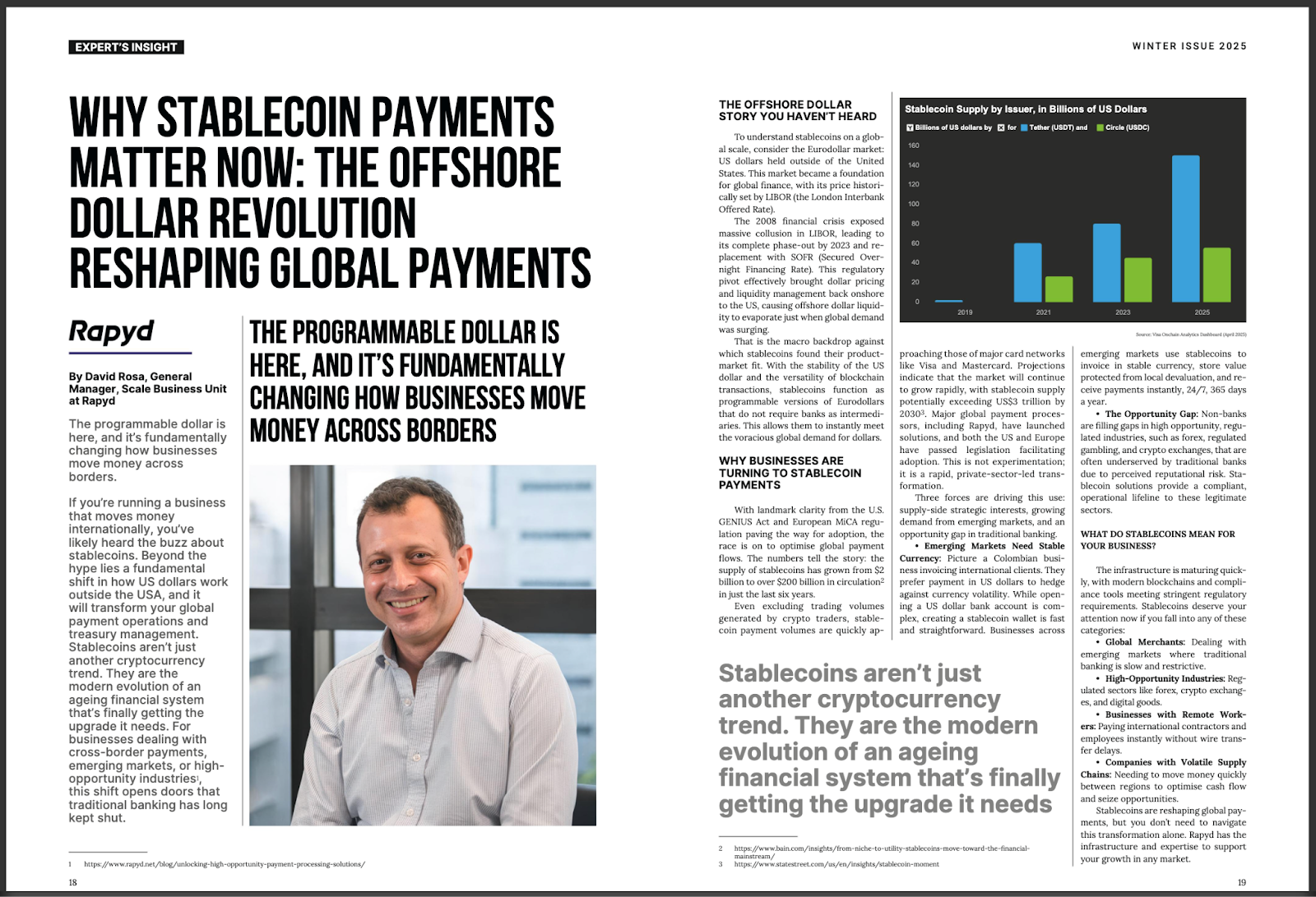
Why Stablecoin Payments Matter Now: The Offshore Dollar Revolution Reshaping Global Payments
By: David Rosa, General Manager, Scale Business Unit at Rapyd
The programmable dollar is here, and it’s fundamentally changing how businesses move money across borders.
The programmable dollar is here, and it’s fundamentally changing how businesses move money across borders.
If you’re running a business that moves money internationally, you’ve likely heard the buzz about stablecoins. Beyond the hype lies a fundamental shift in how US dollars work outside the USA, and it will transform your global payment operations and treasury management. Stablecoins aren’t just another cryptocurrency trend. They are the modern evolution of an ageing financial system that’s finally getting the upgrade it needs. For businesses dealing with cross-border payments, emerging markets, or high-opportunity industries, this shift opens doors that traditional banking has long kept shut.
The Offshore Dollar Story You Haven’t Heard
To understand stablecoins on a global scale, consider the Eurodollar market: US dollars held outside of the United States. This market became a foundation for global finance, with its price historically set by LIBOR (the London Interbank Offered Rate).
The 2008 financial crisis exposed massive collusion in LIBOR, leading to its complete phase-out by 2023 and replacement with SOFR (Secured Overnight Financing Rate). This regulatory pivot effectively brought dollar pricing and liquidity management back onshore to the US, causing offshore dollar liquidity to evaporate just when global demand was surging.
That is the macro backdrop against which stablecoins found their product-market fit. With the stability of the US dollar and the versatility of blockchain transactions, stablecoins function as programmable versions of Eurodollars that do not require banks as intermediaries. This allows them to instantly meet the voracious global demand for dollars.
Why Businesses Are Turning to Stablecoin Payments
With landmark clarity from the U.S. GENIUS Act and European MiCA regulation paving the way for adoption, the race is on to optimise global payments. The numbers tell the story: the supply of stablecoins has grown from $2 billion to over $200 billion in circulation in just the last six years.
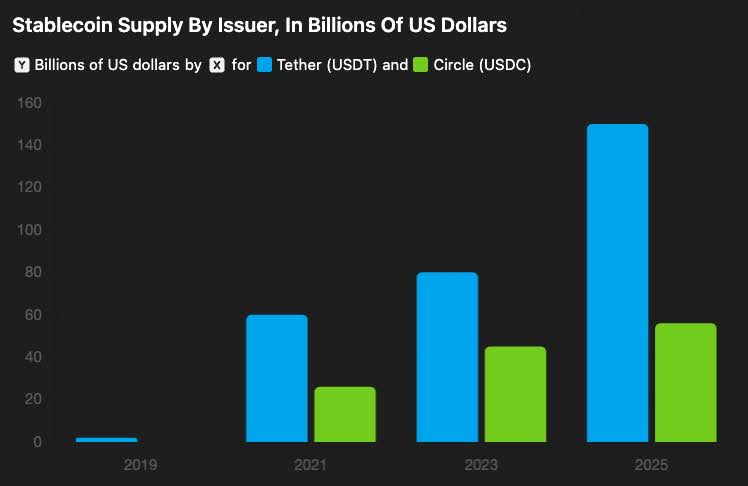
Source: Visa Onchain Analytics Dashboard (April 2025)
Even excluding trading volumes generated by crypto traders, stablecoin payment volumes are quickly approaching those of major card networks like Visa and Mastercard. Projections indicate that the market will continue to grow rapidly, with stablecoin supply potentially exceeding US$3 trillion by 2030. Major global payment processors, including Rapyd, have launched solutions, and both the US and Europe have passed legislation facilitating adoption. This is not experimentation; it is a rapid, private-sector-led transformation.
Three forces are driving this use: supply-side strategic interests, growing demand from emerging markets, and an opportunity gap in traditional banking.
- Emerging Markets Need Stable Currency: Picture a Colombian business invoicing international clients. They prefer payment in US dollars to hedge against currency volatility. While opening a US dollar bank account is complex, creating a stablecoin wallet is fast and straightforward. Businesses across emerging markets use stablecoins to invoice in stable currency, store value protected from local devaluation, and receive payments instantly, 24/7, 365 days a year.
- The Opportunity Gap: Non-banks are filling gaps in high-opportunity, regulated industries, such as forex, regulated gambling, and crypto exchanges, that are often underserved by traditional banks due to perceived reputational risk. Stablecoin solutions provide a compliant, operational lifeline to these legitimate sectors.
How Stablecoins Create Working Capital Efficiency
Stablecoins radically improve working capital efficiency and liquidity management for global merchants. Consider a global e-commerce business based in the Netherlands with revenues in Colombian Pesos:
- Under the Traditional route, the process is cumbersome: Pesos must be converted to US Dollars (due to better liquidity), then converted to Euros, and finally sent via SWIFT through multiple correspondent banks. This entire process takes 2–5 days, locking funds in transit, creating complex reconciliation issues, and exposing the company to high FX risk.
- The Stablecoin route streamlines this. Pesos are converted directly to Stablecoins, transferred instantly to an EU-based account, and then converted and settled into Euros in the Dutch treasury account. This process takes only minutes, providing zero settlement risk, real-time visibility, and completely cutting out inefficient correspondent banks.
Modern treasury teams are already utilizing stablecoins like USDT and USDC. Boston Consulting Group estimates that corporate treasury accounts for 5-10% of total stablecoin payment transactions. Why? Because stablecoins provide instant, global liquidity deployment. When a daily liquidity need arises in a subsidiary on the other side of the world, stablecoins act as your treasury’s rapid response tool, eliminating the need to wait days for SWIFT transfers.
What Do Stablecoins Mean for Your Business?
The infrastructure is maturing quickly, with modern blockchains and compliance tools meeting stringent regulatory requirements. Stablecoins deserve your attention now if you fall into any of these categories:
- Global Merchants: Dealing with emerging markets where traditional banking is slow and restrictive.
- High-Opportunity Industries: Regulated sectors like forex, crypto exchanges, and digital goods.
- Businesses with Remote Workers: Paying international contractors and employees instantly without wire transfer delays.
- Companies with Volatile Supply Chains: Needing to move money quickly between regions to optimize cash flow and seize opportunities.
Stablecoins are reshaping global payments, but you don’t need to navigate this transformation alone. Rapyd has the infrastructure and expertise to support your growth in any market.



Subscribe Via Email
Thank You!
You’ve Been Subscribed.