


Essential Strategies to Navigate Iceland’s Payment Landscape
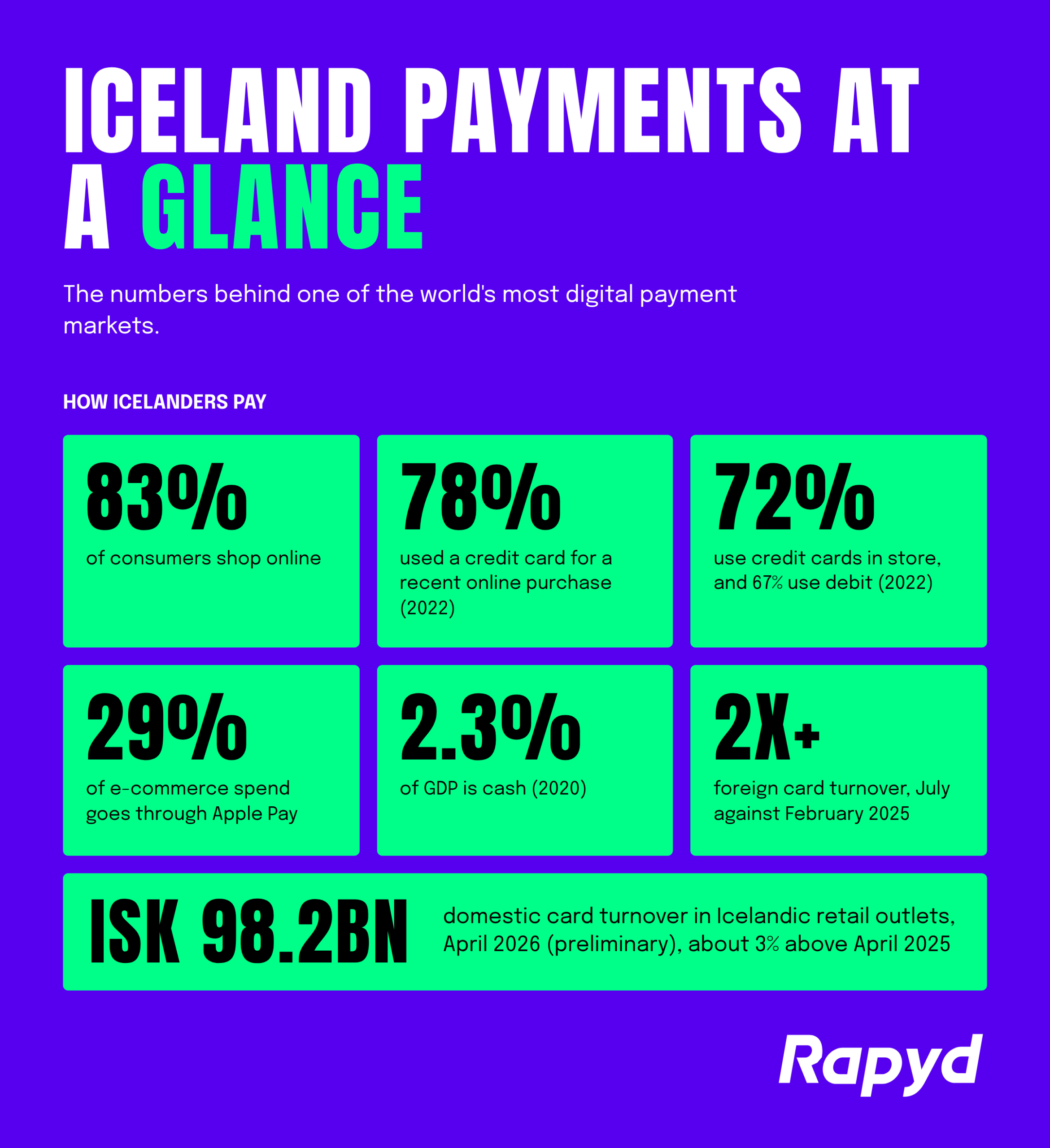
Iceland is one of the most digital payment markets you’ll sell into. When the European Payments Council profiled it in 2020, cash stood at roughly 2.3% of GDP.
Cards still do the heavy lifting. Preliminary Central Bank figures show domestic card turnover in Icelandic retail outlets reached 98.2 billion ISK in April 2026, about 3% above April 2025. That’s slower than the 5.3% year-over-year growth the Central Bank reported for February 2024. Plan for a mature market with steady growth.
New instant payment plans are on the way too, and we cover them below.
Knowing how Icelanders pay, and what they expect at checkout, decides whether visitors become buyers or leave.

An Overview of Iceland’s Payment Landscape
Iceland pairs advanced payment technology with an island economy. 83% of consumers shop online, so your digital audience is large.
Cash plays a small part. In many large advanced economies, cash sits at 8 to 10% of GDP. Iceland’s 2.3% figure from 2020 puts it among the global leaders in payment digitisation.
Tourism adds a second layer. Seasonality is a long-running challenge: a 2013 BCG report found that around half of all visitors arrived in just three months. The June to August high season still brings the biggest wave of international visitors, and card data shows the swing. Turnover on foreign cards in Iceland was ISK 50.6 billion in July 2025, against ISK 21.7 billion in February 2025. That’s more than double.
Your payment infrastructure must handle multi-currency processing, heavy transaction volume at tourist sites and summer surge capacity. It also has to stay economical through the winter months, when the permanent resident base is small.
The World Bank documents a real-time payment system that runs 24/7/365 with universal financial institution participation. Shoppers who move money between people instantly will expect the same speed from your checkout.
Statistics Iceland puts 2025 GDP at a preliminary 4,956 billion ISK, about €34 billion at recent exchange rates, with real growth of 1.3%. Its first estimate for 2024 was 4,616 billion ISK, before later revisions. Card spending tells the same story: steady expansion, not a sudden surge.
How Iceland’s Consumers Pay Online
Credit cards lead online payments in Iceland. Rapyd’s 2022 research found 78% used credit cards for a recent online purchase, and 46% consider credit cards their first-choice method.
Support Visa and Mastercard across credit and debit. The Central Bank says transactions run almost exclusively through these two networks. Need to add American Express too? Rapyd is a principal member of Visa, Mastercard and Amex, and supports card acceptance for all three in Iceland.
Digital wallets are already mainstream. Visa’s research found Apple Pay is Iceland’s most popular wallet, reaching 29% of all e-commerce spend, and that digital wallets account for nearly 30% of e-commerce spend across the Nordic region. Card on file is just as established: the same study found 74% of consumers in Sweden and Iceland save their card details with merchants. Rapyd supports Apple Pay and Google Pay in Iceland, plus tokenisation for card on file.
In-Store Payment Preferences
Iceland’s shops run on cards. Rapyd research confirms 72% of consumers use credit cards for in-store purchases and 67% use debit cards. Fewer than 1% choose cash first, although about 1 in 4 still used it for a recent purchase.
Card acceptance is a requirement for commercial viability in Iceland. Consumers expect it even for small-value purchases. Build your point-of-sale setup around cards and treat cash as the exception.
Resilience matters at the till. The Central Bank calls the ability to pay by card without an internet connection a vital part of payment resilience, and said in June 2026 that an offline card payment solution would be implemented in mid-2026. Rapyd terminals support offline payments, capturing them securely during network outages and processing them once the connection returns.
For retailers operating during Iceland’s tourism season, multi-currency processing is necessary. International visitors bring a mix of card networks and currencies, and Rapyd accepts payments in 150+ currencies. Your POS systems must cope when foreign card turnover more than doubles above winter levels.
What Rapyd’s In-Store Payments Cover
Rapyd’s in-store payments run alongside your online payments through one provider, with unified reporting across channels.
- The cards your customers carry: Accept Visa, Mastercard and American Express.
- Pay in their own currency: Dynamic Currency Conversion lets international visitors pay in their home currency at the point of sale. Terminal screens localise to 13 languages based on the card BIN.
- Keep selling offline: Offline support captures payments during network outages and processes them when the connection returns.
- Tap to Pay: Accept contactless payments, including Apple Pay and Google Pay, on supported iOS and Android devices with no extra hardware. It suits pop-ups, mobile sales and busy periods. Tap to Pay is available across the UK and EEA, and iPhone availability follows Apple’s list of supported regions.
- Deposits, tips and split bills: Pre-authorisations, tipping and split billing are supported on the terminal.
- Fast access to funds: Get your money as quickly as the next business day in your preferred currency.
- Connect your till: CloudLink and LocalLink connect terminals to your existing electronic cash register and POS software.
Regional Market Quirks
Tourism seasonality creates sharp swings in transaction volume, so your infrastructure planning needs to stay flexible. A 2013 BCG report hosted by the Icelandic Tourist Board lists reducing seasonality among tourism’s main challenges, and the pressure on businesses hasn’t gone away.
Plan for foreign card volumes to more than double in summer, while keeping costs sensible across the winter months with a small permanent population. Seasonality affects cash flow projections, support capacity planning and the case for infrastructure investment.
Launch timing matters in this seasonal market:
- Enter before June: Capture peak tourism demand during your first season.
- Use October through May: Test and optimise during lower-volume periods, when mistakes carry less revenue impact.
- Prepare for the summer surge: Scale capacity for foreign card volumes that more than double between winter and July.
Iceland’s card-first habits set high expectations. Your payment experience should match the quality of Iceland’s 24/7/365 real-time banking infrastructure and its widespread contactless acceptance.
What Iceland’s New Instant Payment Plans Mean for You
Instant transfers between people are already common in Iceland, but there’s no widely adopted way to pay a merchant straight from a bank account. Two projects are set to change that.
- A new domestic payment scheme: On 30 October 2026, the Central Bank said it had started public procurement for the core of a new domestic account-to-account (A2A) payment infrastructure. It’s based on request-to-pay and built on the Central Bank’s existing instant credit transfer rails. Banks and payment firms would build the apps and merchant services, so shoppers could pay from their bank accounts in stores, online and person to person. No launch date has been announced.
- TIPS membership: On 24 June 2026, the ECB and the Central Bank of Iceland signed an agreement for Iceland to join the Eurosystem’s TARGET Instant Payment Settlement (TIPS) system. Payments in Icelandic króna will settle instantly in central bank money from 2028, making the króna the fifth currency on TIPS. No final go-live date has been set.
Why does it matter? The Central Bank says near-total reliance on Visa and Mastercard leaves Iceland exposed if connectivity or critical payment services fail, and it wants a second payment route.
What should you do now?
- Keep cards and wallets first: They’re how Icelanders pay today.
- Choose a flexible setup: Rapyd supports bank transfers in Iceland today, and its platform covers real-time payment networks and A2A flows.
- Watch for announcements: Check Central Bank updates for launch dates and merchant requirements.
Iceland Market Entry Strategy
Here’s how you can capture more payments from Iceland’s consumers.
Offer Expected Payment Methods
Your payment setup depends on four elements:
- Visa, Mastercard and American Express: Support credit and debit variants across all three networks. With 78% of Icelandic online shoppers using credit cards in Rapyd’s 2022 research, a checkout without comprehensive card support misses the baseline.
- Apple Pay and Google Pay: Launch them alongside your cards. Apple Pay alone reaches 29% of Icelandic e-commerce spend.
- Mobile-ready checkout: Design for the growing share of transactions on mobile devices. Icelandic shoppers expect desktop-quality functionality on a phone. Rapyd’s online payments include localised checkout, which adapts to customer location, language, currency and preferred payment methods.
Respect Localisation Requirements
Showing prices in Icelandic krona (ISK) builds consumer trust, even if your backend processing runs through EUR or USD payment gateways. International businesses often operate in major currencies, but ISK pricing shows genuine commitment to the market. Rapyd supports settlement in your preferred currency, including ISK, and every Rapyd client also gets a Rapyd Wallet, a multi-currency business account.
An Icelandic checkout will likely improve conversion, despite Iceland’s high English proficiency. Prioritise translation for checkout flows, product descriptions and return policies over less critical content. These areas directly affect purchase decisions and trust.
Build Trust with Iceland Consumers
Make your privacy policies prominent and specific about where you store data and how you handle it.
If you register for Icelandic VAT, display your kennitala, the identification number Iceland issues to businesses and individuals. According to Skatturinn, the Icelandic tax authority, registration is required once taxable sales pass ISK 2,000,000 in any 12-month period, roughly €14,000 at recent exchange rates. The rules vary by what you sell and who you sell to, so check your position with a tax adviser. A visible kennitala signals that you’re committed to the market.
Local presence indicators build credibility, even if you operate internationally:
- Icelandic contact information: Phone numbers and support hours in local time.
- Iceland-specific shipping details: Clear delivery timelines and local logistics partners.
- Local return handling processes: Tailored to Icelandic postal services and consumer expectations.
Explore Rapyd’s Icelandic capabilities at rapyd.net/is.



Subscribe Via Email
Thank You!
You’ve Been Subscribed.