Modern payment API infrastructure can reduce back-office work and improve payment experiences for merchants and customers. Here’s everything you need to know
Payment infrastructure has shifted from a back-office utility to a revenue lever. Miss a beat at checkout? Your customer’s already gone. Whether you’re selling subscriptions, running a marketplace or building the next fintech sensation, fast, reliable checkout makes all the difference.
Behind every smooth transaction sits a payment API—the quiet bridge connecting your app to the payments world. These APIs handle everything: authorisations, refunds, subscription billing and payouts.
Pick the wrong provider and your growth will hit a wall. Choose right and you’ll see higher acceptance rates and access to global markets through a single integration. Ready to see how the right payment API can enhance your business? Let’s dive in.
What Is a Payment API?
A payment API is a software interface that connects your application to payment gateways and banking networks so you can move money online. It authenticates each request, passes it through encrypted channels then returns a clear approval or decline.
Through one integration, you gain core actions—authorise, capture, refund, tokenise, manage subscriptions, send payouts and pull transaction data—without handling raw card details.
What Does a Payment API Do?
A payment API handles everything from processing payments to managing refunds, all while keeping your customers’ data safe and secure. It’s a type of fintech API that creates connections between customers, merchants and financial institutions.
Accepting Payments
When your customer hits the “buy now” button, the payment API creates a secure tunnel for payment data, whether it’s through cards, bank transfers or ewallets, to travel from their account to your settlement account.
The process happens in three key steps: payment initiation (customer confirms purchase), authorisation (system checks for available funds and potential fraud) and settlement (money actually changes hands).
Handling Different Payment Methods
Your customers want choices when paying. The right payment API brings multiple payment methods under one roof, like credit card payments, digital wallets, bank transfers and local payment methods specific to different markets.
This matters for global business. With the mobile payments revolution in full swing, shoppers frequently abandon purchases when they cannot use their preferred payment method.
Why Use a Payment API? Key Benefits & Real-World Applications
The key benefit of a payment API is the level of control and customisation it offers, allowing businesses to design a payment experience tailored to their needs.
- Tailored UI and UX: The API gives you full control over the user interface and user experience. You can customise the checkout process to match your brand’s identity, creating a smooth, intuitive journey for customers across all platforms
- End-to-end automation: Integrating the API with your back-office and billing systems automates the entire payment process, from initiation to settlement. This reduces manual tasks, improves workflows and enhances operational efficiency
- Smooth checkout: The API creates a smooth checkout experience with no redirection to third-party pages. Customers complete transactions within your platform, improving satisfaction and reducing cart abandonment rates
- Scalability and flexibility: As your business grows, the API scales with you. It can handle increased transaction volumes, adapt to new markets and integrate additional payment methods with ease.
- Data insights and reporting: The API offers real-time access to transaction data, providing valuable insights into customer behaviour and financial performance. Custom reports help you make data-driven decisions and optimise your payment process.
Payment APIs fuel different business models across industries. Here’s how various sectors use payment capabilities to drive success.
Payment APIs Real-World Application #1: eCommerce Platforms
Online stores depend heavily on payment APIs to serve customers. Imagine a growing fashion retailer using a payment API to handle regional preferences as it expands globally. By implementing a flexible system, this retailer can offer favourite local payment methods in each market, all through one integration.
The same payment API simplifies backend operations by automatically reconciling transactions across these different payment methods and reduces accounting headaches as the business grows internationally.
Payment APIs Real-World Application #2: Subscription Services
Streaming platforms and SaaS companies rely on payment APIs to manage their recurring billing.
A streaming service using a payment API can automate the entire subscription lifecycle, from free trials to upgrades, downgrades and cancellations. The payment API handles failed payment retries with smart strategies that minimise customer loss when cards expire or lack funds.
This automation extends to complex scenarios like promotional pricing, annual vs. monthly billing and updates to expired payment methods which are all important capabilities for subscription businesses.
Payment APIs Real-World Application #3: Mobile Apps
App developers face distinct integration challenges when monetising through in-app purchases and subscriptions. Unlike traditional eCommerce, they need to handle different mobile platforms and still deliver a smooth payment experience.
What to Look For in a Payment API Provider
Choosing the right payment API provider directly impacts your revenue and operational efficiency. Focus on these core capabilities when evaluating options.
Local Acquiring in Your Key Markets
Cross-border payment processing significantly reduces your authorisation rates. When you process transactions through an acquirer in a different country than your customer, banks view these as higher risk and decline more transactions.
Work with a provider that holds acquiring licences in the markets where you do business. Local acquiring relationships with card networks result in higher approval rates and fewer false declines that cost you revenue.
Cards Plus Alternative Payment Methods
Credit and debit card acceptance forms the foundation of online payments. However, your customers increasingly expect additional options at checkout.
You need to accept major credit cards. Adding alternative and locally preferred payment methods like Apple Pay, Google Pay, local real-time payment networks and stablecoin can increase conversions.
Different markets have different preferences. Customers in one region might prefer bank transfers while those in another favour digital wallets or mobile ewallets.
Fast Onboarding
Time to revenue matters when you need to accept payments quickly or expand into new markets. Lengthy onboarding processes delay your ability to generate income and slow market expansion.
Evaluate how quickly a provider can get your business operational. Some merchants need to start accepting payments within days, not weeks or months. Choose a provider whose onboarding timeline aligns with your business needs.
End-to-End Capabilities
Most businesses need to do more than accept payments. They also need to hold and manage funds, exchange currencies and send payments to suppliers, contractors and partners.
A solution that provides payment acceptance, payouts and multi-currency accounts can dramatically simplify operations. Managing these functions through separate providers creates reconciliation challenges and operational overhead that slows your team down.
The Ability to Support Your Industry
You need a provider that understands your business, especially in complex industries like iGaming, online trading and digital goods. Traditional payment processors often decline businesses in these sectors or impose restrictive terms.
Make sure you choose a provider with proven experience serving your industry. They should understand your specific compliance requirements, transaction patterns and business model challenges.
How Rapyd Leads With A Global Payment API
Rapyd’s payment API delivers the capabilities international businesses need to maximise revenue and expand globally through a single integration.
Local Acquiring in the Places Where You Do Business
Cross-border processing significantly reduces your authorisation rates. Work with a payment solution provider that offers local acquiring in your key markets.
Rapyd’s multi-licence advantage gives international businesses local acquiring in the UK, Europe, LATAM, Singapore and Israel. This means higher approval rates and more captured revenue in each market you serve.

Cards Plus Alternative Payment Methods
You need to accept credit cards online. Offering local and alternative payment methods such as Apple Pay, Google Pay, bank transfers and stablecoin can significantly increase conversions.
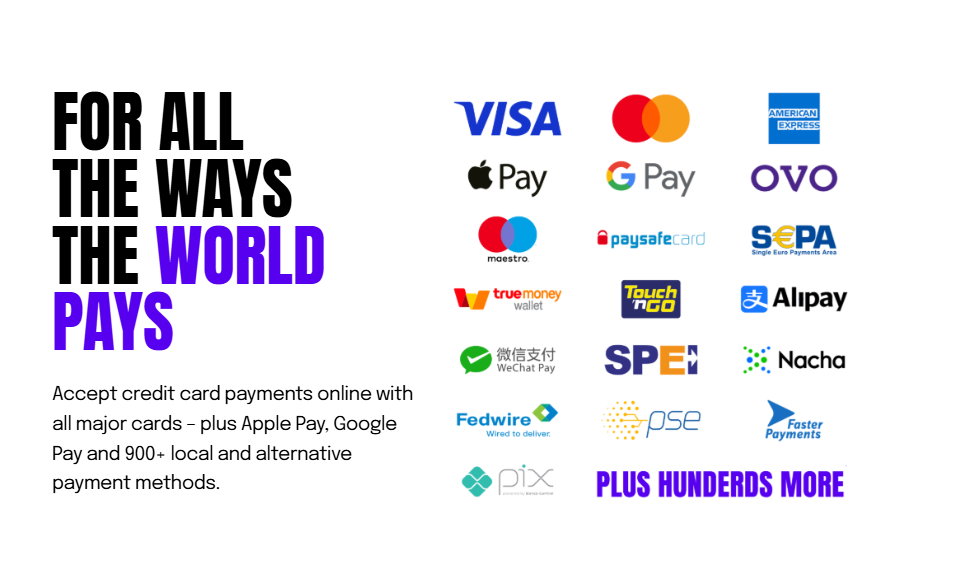
Rapyd supports 900+ payment methods worldwide, giving your customers the payment options they prefer in each market. This comprehensive coverage reduces cart abandonment and drives higher conversion rates.
Fast Onboarding
Rapyd onboards most merchants in less than 24 hours. When expanding your business cross-border, time to revenue matters.
Fast onboarding means you can start accepting payments and generating revenue quickly whether you’re launching in a new market or adding payment capabilities to an existing operation.
High Authorisation Rates
Authorisation rates are one of the most powerful ways to drive revenue because you capture sales you’ve already paid for by bringing customers to your site. A false decline represents lost revenue that you should have earned.
Rapyd has some of the highest authorisation rates globally as a leading acquirer trusted by 250,000 merchants worldwide. Higher approval rates mean more revenue from your existing traffic and marketing investments.
End-to-End Payments
If you’re accepting and sending payments, you can simplify operations and accelerate growth by choosing a payment solution that offers both.
Rapyd’s Disburse platform provides payouts to 190+ countries, including hard-to-reach developing markets with bank transfers, instant card payouts, ewallets and stablecoin.
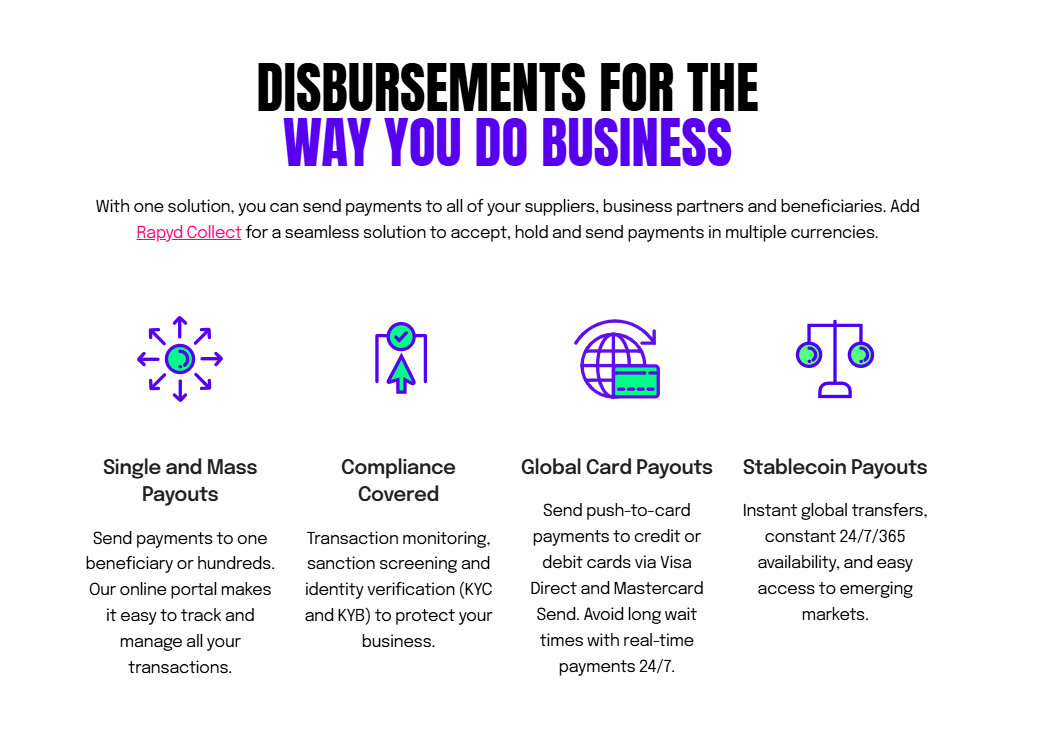
Managing both payment acceptance and disbursements through one provider reduces complexity and improves operational efficiency.